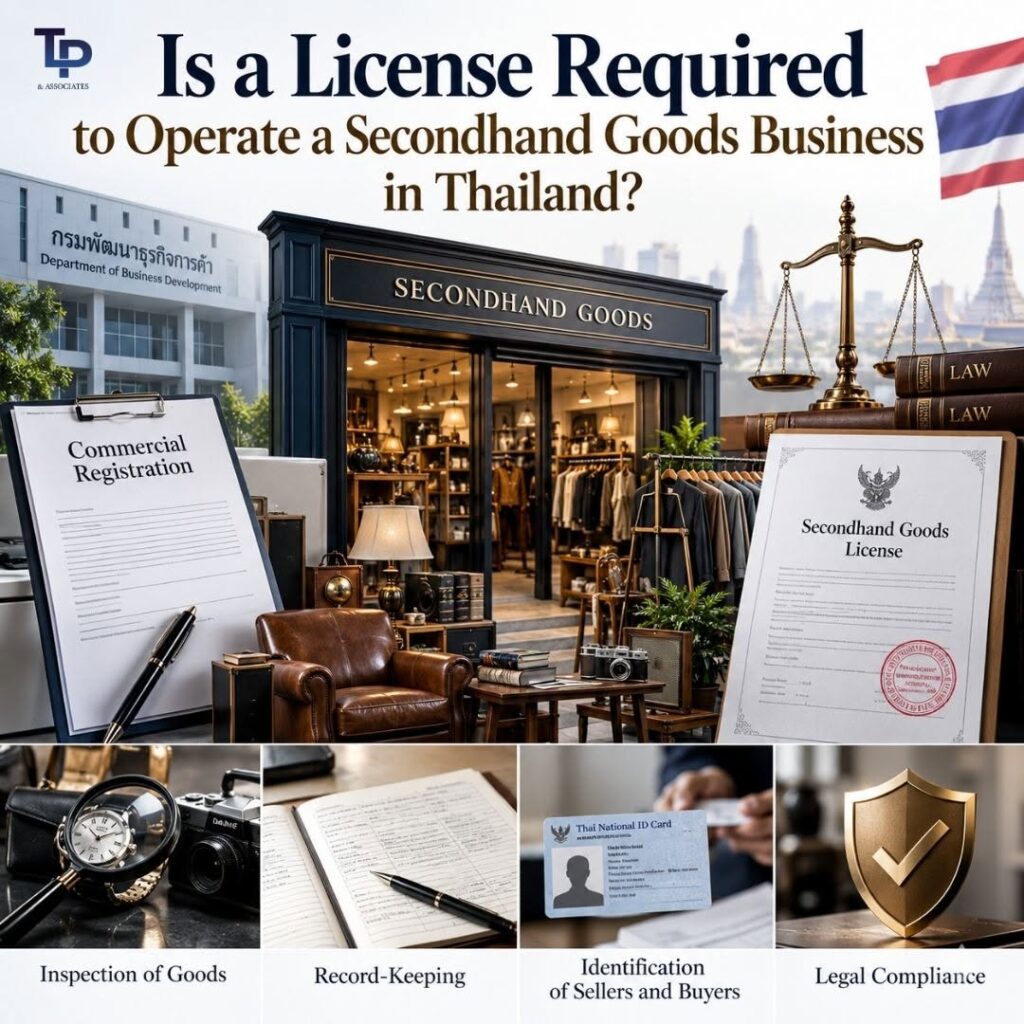
Operating a secondhand goods business in Thailand is not as simple as opening a shop and starting operations immediately. This type of business is regulated by several laws, including those relating to commercial registration, taxation, and specific licensing requirements.
1. Basic Business Registration
As a general rule, any person conducting a commercial business that falls within the legal criteria must register under the Commercial Registration Act B.E. 2499 (1956). If operating as an individual, the business owner must register with the local commercial registration office in the area where the business is located. If operating as a limited company or partnership, the entity must be registered with the Department of Business Development. In addition, all business operators are required to comply with tax laws, including income tax and any other applicable taxes.
2. Secondhand Goods License as a Specific Legal Requirement
A secondhand goods business is subject to additional licensing requirements under the Control of Auction Sales and Trade in Secondhand Goods Act B.E. 2474 (1931). Anyone engaging in the trade of secondhand goods must obtain a license from the authorized licensing officer before commencing operations. The primary objective of this law is to prevent the circulation of property obtained through unlawful acts, such as theft, robbery, fraud, or money laundering. Before issuing a license, authorities will examine. The applicant’s qualifications (for example, whether the applicant has a criminal record relating to property offenses), and The suitability of the business premises, to ensure that the operation will not negatively affect the surrounding community.
3. Duties of a Licensed Operator
Once a license is granted, the operator must comply with legal conditions, including: Maintaining a register or record book of all secondhand goods purchased and sold,
Recording details of each item (such as type, characteristics, and registration number if applicable), and Identifying the seller and the buyer to allow traceability of the goods.
Such record-keeping enhances transparency, supports crime prevention efforts, and increases public confidence in licensed shops.
4. Relationship Between Commercial Registration and the Secondhand Goods License
A commercial registration certificate is one of the required supporting documents when applying for a secondhand goods license under the Ministry of Interior Regulations on Auction Sales and Trade in Secondhand Goods B.E. 2533 (1990). Therefore, an individual operator must possess both: A commercial registration certificate, and A secondhand goods trading license to be considered fully compliant with the law.
Conclusion
To legally operate a secondhand goods business in Thailand, several steps must be completed: commercial registration (or company registration), proper tax compliance, and—most importantly—obtaining a secondhand goods license under the specific governing law. Failure to comply with any of these requirements may result in legal penalties. Anyone interested in opening a secondhand goods shop should ensure that all necessary documentation and procedures are completed from the outset to operate lawfully, transparently, and with public trust.